_画板-111.png)
The ‘Spring Forward’ Effect: Engineering Magnesium-Infused Patches for Cortisol Acne
_画板-1-1-300x300.png)
Alps Medical
15 Years of Acne Patch Factory Manufacturing and Wholesale
Table of Contents
Mark your calendars: March 9th, 2026. That is the Daylight Savings switch. For the skincare market, this isn’t just a lost hour of sleep; it is a guaranteed spike in cortisol-induced acne. When consumers lose sleep, their stress hormones spike, oil production goes into overdrive, and inflammation follows.
Most brands treat this as a standard breakout issue. They push high-dose Salicylic Acid or drying agents. This is a strategic error. Stress-weakened skin barriers cannot handle aggressive treatments. The market is currently underserved by patches that address the root cause—stress and inflammation—rather than just the symptom.
At DOTDOT, we are seeing a sharp rise in “Neuro-cosmetic” requests. Brand owners want a product that bridges the gap between treatment and wellness. This is where Magnesium-infused patches enter the chat. Here is the engineering logic and the supply chain strategy to capitalize on the ‘Spring Forward’ spike.
[图片: 实验室显微镜下的镁离子微粒与水胶体融合特写]
The Science: Why Magnesium, Why Now?
Standard hydrocolloid patches are passive. They absorb gunk. They don’t actively soothe the “panic” signal in the skin. Magnesium, however, is a known relaxant. In a topical patch format, it serves two distinct purposes that your competitors are missing:
- Barrier Support: Magnesium helps stabilize the skin barrier, which cortisol (stress hormone) degrades.
- Inflammation Control: It reduces the visual redness that makes stress-pimples look worse than they are.
The problem? Magnesium is a mineral. Hydrocolloid is a polymer. Generic factories often struggle to marry the two without compromising adhesive strength. The mineral particles clump, or the patch turns chalky. This ruins the aesthetic and the efficacy.
Engineering Challenges: The OEM Difference
When you approach a standard supplier with a custom ingredient request, you often hit a wall. They want to run 50,000 units minimum just to test a new blend. This kills innovation speed.
At DOTDOT, we solved this by pre-engineering functional hydrocolloid matrices. We don’t just “mix in” ingredients. We stabilize Magnesium Oxide within the Carboxymethyl cellulose (CMC) structure. This ensures:
- Particle Distribution: No gritty texture. The patch remains smooth and translucent.
- Adhesion Integrity: Our adhesive system is calibrated to work *with* mineral ions, preventing the patch from peeling off oily T-zones.
- Rapid Release: The mineral releases upon contact with the exudate, delivering active benefits immediately.
Market Strategy: Visual & Structural Customization
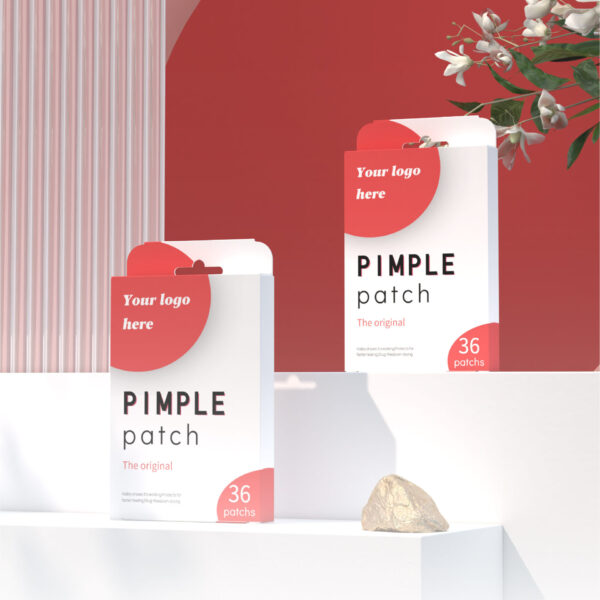
Private Labeling isn’t just about slapping your logo on a box. It is about shelf presence. For a “Stress Acne” patch, the physical product needs to communicate “Calm” instantly.
We recommend moving away from the standard circular patch for this specific SKU. Our design team suggests:
- “Moon” or “Crescent” Shapes: Visually signaling sleep and night-time recovery.
- Tinted Backings: A subtle lavender or periwinkle tint (mineral-based, safe for sensitive skin) to differentiate from the clear/standard patches on shelf.
- Eco-Materials: Positioning the “wellness” patch on a biodegradable paper backing. It appeals to the conscious consumer who links stress with environmental stress.
The Supply Chain Bottleneck vs. DOTDOT Agility
The biggest risk for the March 2026 timeline is lead time. If you wait until January to develop a custom formula, you miss the sales window. Traditional manufacturing is notoriously slow.
Here is the realistic comparison between Industry Standard and the DOTDOT model:
| Feature | Standard Factory | DOTDOT (OEM/ODM) |
|---|---|---|
| MOQ for Custom Formula | Often 50,000 – 100,000 units | 1,000 Units (Ideal for market testing) |
| Prototyping Speed | 4-6 Weeks | 7 Days (Rapid Prototyping) |
| Ingredient Stabilization | Third-party lab testing (Costly/Delayed) | In-house ISO 13485 Lab (Fast/Vetted) |
| Material Options | Standard Standard Hydrocolloid only | Fully Biodegradable & Medical Grade Options |
We operate this way because we know Procurement Managers hate sitting on dead stock. Low MOQs allow you to launch a “Daylight Savings Survival Kit” without betting the quarter’s budget on unproven SKUs.
Sourcing Checklist: What to Ask Your Manufacturer
If you are evaluating a supplier for your Magnesium patch line, ask these three questions immediately. If they hesitate, walk away.
- “Show me your adhesion data with mineral infusion.” Minerals can act as bond breakers. You need proof the patch stays stuck for 8+ hours.
- “What is your particle size distribution?” If the Magnesium particles aren’t micronized, the patch will look white and cheap on the skin.
- “Can you certify the device classification?” Make sure your patch is compliant. We provide FDA registration support and ISO certification upfront to prevent customs delays.
Frequently Asked Questions (Procurement Focus)
Q: Is a Magnesium patch considered a drug?
A: Not necessarily. It depends on your marketing claims. If you claim it “treats anxiety,” that is a drug claim. If you claim it “soothes acne appearance and reduces redness,” it falls under cosmetic/medical device class I. DOTDOT provides compliant copy guidelines to protect your brand.
Q: Does the production of Magnesium patches take longer?
A: Not with us. We have already validated the Magnesium-Hydrocolloid matrix. Since we don’t outsource our core mixing, your timeline remains consistent with standard patch production.
Q: What is the shelf life?
A: Magnesium is stable, but the adhesive can degrade if stored poorly. We guarantee a 3-year shelf life with proper packaging. We recommend aluminum foil pouches for this specific SKU to maintain maximum potency.
Ready for March?
The ‘Spring Forward’ effect is a predictable, recurring sales event. Don’t let it pass with generic products. A Magnesium-infused patch positions your brand as a solutions provider for the modern, stressed consumer.
We are currently booking production slots for Q4 2025 to ensure Q1 2026 delivery. Do not wait for the R&D bottleneck.